

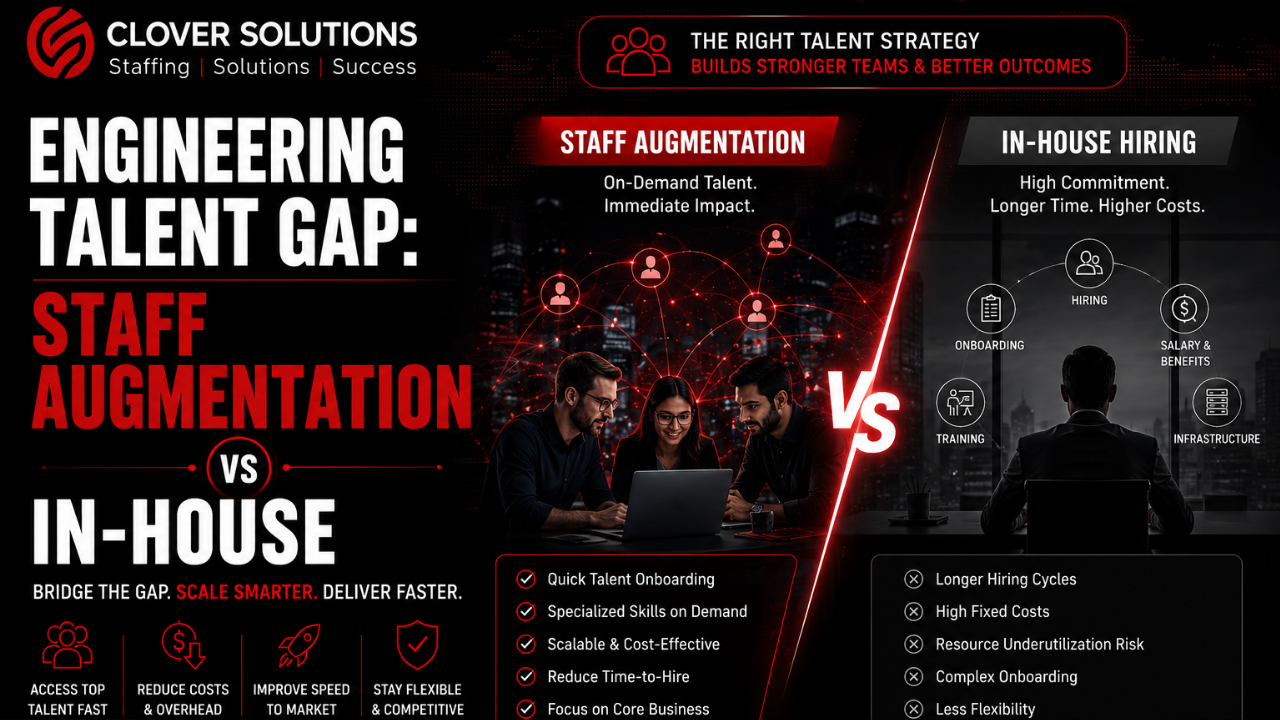
Bridging the Engineering Talent Gap: Staff Augmentation vs. In-House Teams
Engineering leaders in 2026 are stuck between two conflicting realities: strong intent to grow, and a shrinking ability to actually execute on it. Furthermore, Robert Half’s 2026 Demand for Skilled Talent report captures this tension precisely — 87% of tech leaders are optimistic about the year ahead and 61% are planning headcount growth, yet 65% report that finding qualified talent is harder than it was a year ago, and only 7% say they have the skills in-house to execute their most critical projects. Consequently, the gap between what engineering teams want to build and what they can actually staff has become one of the defining operational problems of 2026.
The Scale of the Engineering Talent Gap
This isn’t a temporary hiring slowdown. Furthermore, McKinsey’s tech talent gap research finds that 60% of companies cite scarcity of technical talent as a key inhibitor of digital transformation, and generative AI is adding to that demand rather than reducing it – engineers who can work effectively with AI systems are now among the hardest hires in the market. Additionally, longer-term projections from Korn Ferry point to a global shortfall of more than 85 million skilled workers by 2030, with technology cited as among the hardest-hit sectors.
The practical impact shows up directly in hiring timelines. The average time to fill a specialized engineering role in 2026 runs around 88 days – roughly three product releases’ worth of delay for a fast-moving technology team operating in agile sprints. Additionally, full-time domestic hiring in the US typically carries $25,000 to $50,000 in recruiting overhead per engineer, on top of that extended timeline.
Why the Gap Keeps Widening
The root cause isn’t simply “not enough engineers globally” – it’s a structural mismatch. Furthermore, the skills businesses need most today – AI/ML engineering, DevSecOps, cloud architecture, MLOps, and generative AI implementation – are evolving faster than universities and bootcamps can produce qualified graduates. Consequently, even in a market with plenty of engineers overall, the specific combination of skills a given roadmap needs is often genuinely scarce.
Staff Augmentation vs. In-House Hiring: How They Actually Compare
| Factor | Traditional In-House Hiring | Staff Augmentation |
|---|---|---|
| Typical time to fill | 45–90 days for domestic hiring; ~88 days average for specialized roles | Often under two weeks for a matched, pre-vetted engineer |
| Recruiting overhead | $25,000–$50,000 per engineer, on top of salary | Built into the engagement fee — no separate recruiting cost |
| Commitment level | Permanent headcount, harder to scale down | Flexible — scales with project needs |
| Control over work | Full control, engineer is a direct employee | Full control — engineer works inside your team, tools, and process |
| Best for | Core, long-term roles central to your product | Specialized, time-bound gaps and skill sets that are hard to hire for directly |
When In-House Hiring Still Makes Sense
Staff augmentation isn’t a replacement for every hire. Furthermore, roles that are core to your product’s long-term direction, require deep institutional knowledge, or represent leadership positions are usually better served by permanent, in-house hiring — the investment in a longer search is justified by the role’s long-term strategic weight.
When Staff Augmentation Is the Better Call
- The skill is narrow and time-bound. A generative AI implementation project or a cloud migration doesn’t necessarily need a permanent hire once the initiative is complete.
- Speed matters more than a perfect long-term fit. When a specialized role is blocking a roadmap, waiting 88 days for a traditional search often costs more than the engagement itself.
- The skill set is evolving faster than your internal team can absorb. DevSecOps, MLOps, and AI-adjacent engineering are moving quickly enough that bringing in specialized augmented talent can close the gap faster than retraining or a lengthy specialized search.
- You need to test a direction before committing headcount. Augmentation lets a team validate a new technical direction without the sunk cost of a permanent hire if the initiative changes.
What to Look for in an Engineering Staff Augmentation Partner
- Real vetting against your actual stack, not a generic technical test – a candidate should be assessed against the frameworks, tools, and seniority level your project actually requires.
- A straightforward replacement process. If the fit isn’t right, the process for addressing it should be simple, not a negotiation.
- Genuine embedding into your workflow. The engineer should work inside your tools, processes, and team structure – not as an isolated outside vendor.
- Speed that reflects a real bench, not just a promise. A partner with genuinely pre-vetted talent should be able to significantly beat the 45–90 day average of a traditional search.
How Clover Solutions Supports Engineering Staffing
Clover Solutions provides engineering staff augmentation and direct placement across the specialized, hard-to-fill skill sets defining 2026 – cloud architecture, DevSecOps, data engineering, and AI-adjacent engineering roles – vetted against your actual technical requirements, not generic assessments.
Frequently Asked Questions
Q: What is the engineering talent gap, and why is it widening in 2026? A: The engineering talent gap refers to the growing mismatch between the specialized skills companies need (AI/ML, DevSecOps, cloud architecture, MLOps) and the pace at which universities, bootcamps, and traditional hiring pipelines can produce qualified professionals. McKinsey research finds 60% of companies cite talent scarcity as a key inhibitor of digital transformation.
Q: How long does it typically take to fill a specialized engineering role? A: The average time to fill a specialized engineering role in 2026 is around 88 days, and traditional domestic hiring more broadly averages 45 to 90 days, often with $25,000 to $50,000 in recruiting overhead per engineer.
Q: Is staff augmentation cheaper than traditional hiring? A: It depends on the comparison. Staff augmentation typically eliminates separate recruiting overhead and dramatically shortens time-to-fill, but the right comparison is total cost against the outcome – a role central to long-term product strategy may still justify the investment of a traditional in-house search.
Q: What roles are best suited for staff augmentation versus in-house hiring? A: Narrow, time-bound, or rapidly evolving skill sets — like generative AI implementation or a defined cloud migration — are typically well suited to staff augmentation. Roles central to long-term product direction or requiring deep institutional knowledge are usually better as in-house hires.
Q: Does Clover Solutions offer both staff augmentation and permanent engineering placement? A: Yes. Clover Solutions supports contract, contract-to-hire, and direct placement models for engineering roles, allowing clients to match the engagement type to the specific need – whether that’s a time-bound specialized gap or a long-term core hire.
Trying to figure out whether your next engineering hire should be a full-time search or an augmented team member? Contact Clover Solutions for a needs assessment.


