

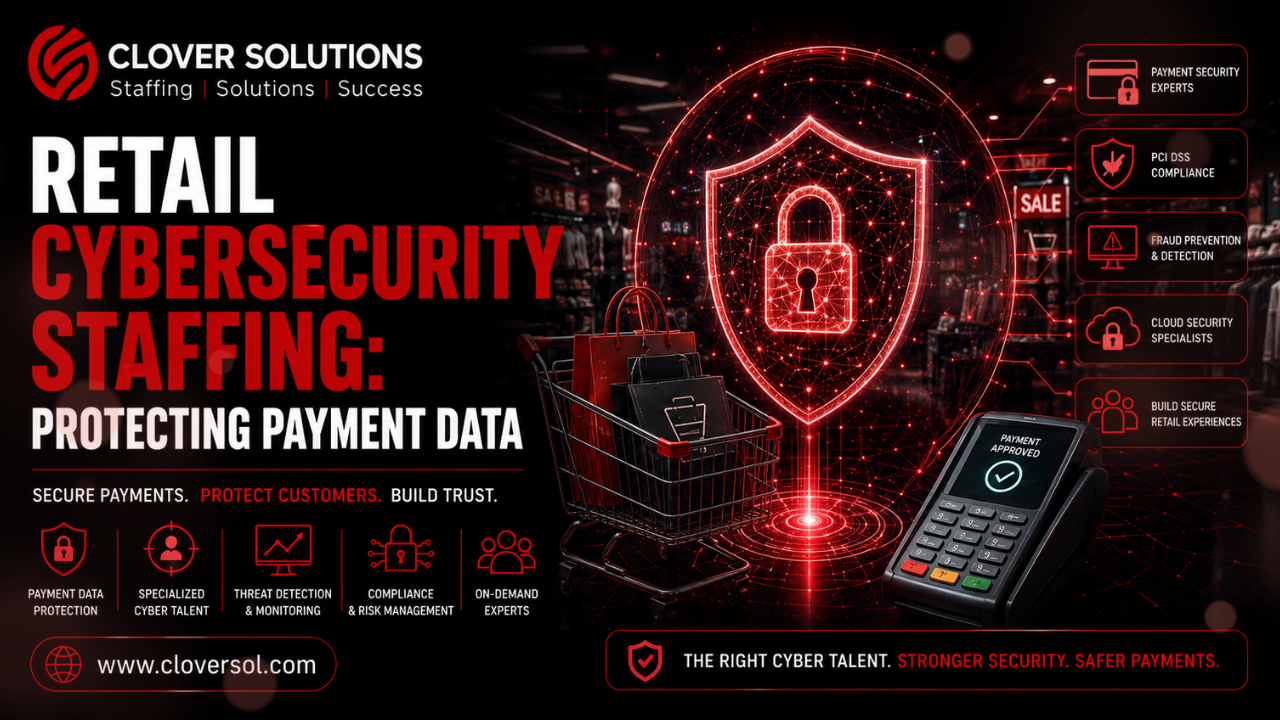
Retail Cybersecurity Staffing: Protecting Customer Payment Data in 2026
Retail had one of its worst years for cybercrime on record in 2025. The data shows the problem isn’t just technology. It’s workforce structure. Ransomware appeared in 44% of all confirmed retail breaches in 2025. That’s up sharply from 32% the year before, according to the Verizon 2025 Data Breach Investigations Report. Retail cybersecurity staffing has moved from a back-office IT concern to a board-level priority. And the roles needed to defend against it are harder to find than most retailers expect.
Why Retail Is Such a Heavily Targeted Sector
Commerce remains the single most attacked industry online. It accounts for 62% of attacks on the sector, according to Akamai’s threat research. The attack surface keeps expanding, too. AI-driven bots now generate 39% of all traffic to online retail sites. And 64% of bot attacks on retail specifically target API business logic rather than traditional login pages. That shift demands a different kind of security engineering than most legacy retail security teams were built for.
Credential-based attacks are especially prevalent. Stolen credentials drove 88% of basic web application attacks in 2025. Credential abuse played a role in 22% of all retail breaches. Account takeover attempts rose approximately 40% year over year. AI-mimicking bots are driving much of that increase — they increasingly evade the CAPTCHA and rate-limiting defenses that worked just a few years ago.
The Workforce Problem Behind the Security Problem
Here’s the part most retailers underestimate: retail’s cybersecurity challenge is deeply tied to how retail staffs itself. Three of the top four cybersecurity challenges retailers report are directly workforce-related. Employee shortages and turnover. Limited internal IT resources to keep pace with modern attack methods. And the seasonal influx of temporary workers during peak periods.
The seasonal workforce gap is particularly stark. VikingCloud’s research found that 78% of temporary employees hired for Q4 peak season received no social engineering training. Furthermore, 56% never got guidance on safe internet and social media use, and 56% received no mock phishing training at all. Retailers with thousands of seasonal employees rotating through point-of-sale, warehouse, and helpdesk roles now count among the highest-risk identity environments of any industry. Human error compounds the problem — it contributes to 68% of data breaches industry-wide, per Verizon.
Where the Retail Cybersecurity Talent Gap Is Concentrated
Application and API security engineers. Most bot attacks now target API business logic rather than traditional entry points. Retailers need security engineers who understand modern application architecture, not just network perimeter defense.
PCI compliance specialists. PCI DSS 4.0.1 made client-side script governance mandatory in March 2025. That turned Magecart-style payment page skimming into a documented control failure rather than a theoretical risk, and it’s driving demand for specialists who can implement and validate these controls.
Identity and access management engineers. Credential abuse sits at the center of most retail breaches, and temporary employees rotate through systems constantly each season. Retailers increasingly treat identity-focused security as its own specialization rather than a general security responsibility.
Third-party and supply chain risk specialists. Verizon’s 2026 report found third-party involvement in breaches reaching 48%. Retail risk increasingly flows through suppliers, cloud platforms, and service providers rather than a retailer’s own systems directly.
Security awareness and training program leads. The seasonal training gap is significant, which makes this an underrated but high-impact hire. These roles build and run onboarding-integrated security training instead of treating it as an annual compliance checkbox.
Retail Cybersecurity Roles: Priority Matrix
| Role | Why It Matters Now | Staffing Consideration |
|---|---|---|
| API/application security engineer | 64% of bot attacks target API business logic | Requires modern app architecture knowledge, not just network security |
| PCI compliance specialist | PCI DSS 4.0.1 client-side controls now mandatory | Needs current, specific PCI 4.0.1 experience |
| Identity/access management engineer | Credential abuse drives a large share of breaches | Especially critical given high seasonal workforce turnover |
| Third-party risk specialist | 48% of breaches involve third-party involvement | Needs vendor and supply chain risk assessment experience |
| Security training program lead | 78% of seasonal hires get no social engineering training | Often overlooked as a distinct, valuable role |
Building a Retail Cybersecurity Staffing Plan That Accounts for Seasonality
- Staff security ahead of seasonal hiring, not alongside it. Retailers name seasonal workforce influx as a top cybersecurity challenge in its own right. Security capacity needs to scale before the seasonal workforce arrives, not catch up afterward.
- Treat application and API security as a distinct specialization. Legacy network-focused security hires often aren’t equipped for the API-centric attack patterns dominating retail today.
- Build security training into onboarding, not as a separate annual event. The data on seasonal employee training gaps points to onboarding as the highest-leverage moment to close this gap.
- Consider flexible staffing for peak-season security monitoring. Retail IT staffing already benefits from flexible models for seasonal technical demand. Security monitoring capacity can scale the same way ahead of high-risk shopping periods.
How Clover Solutions Supports Retail Cybersecurity Staffing
Clover Solutions sources application security engineers, PCI compliance specialists, identity and access management talent, and security program leads for retail organizations. We build our screening around the specific, workforce-driven risk patterns that make retail security different from general enterprise cybersecurity.
Frequently Asked Questions
Q: Why is retail such a heavily targeted sector for cybercrime? A: Retail remains the single most attacked commerce sector online. High transaction volumes, expanding API attack surfaces, and a workforce structure with significant seasonal turnover all create more openings for credential-based and social engineering attacks than in more stable-workforce industries.
Q: What is PCI DSS 4.0.1 and why does it affect retail hiring? A: PCI DSS 4.0.1 introduced mandatory client-side script governance requirements to prevent Magecart-style payment page skimming. It became mandatory in March 2025. That’s increased demand for compliance specialists with current, specific experience implementing these controls.
Q: How does seasonal staffing affect retail cybersecurity risk? A: Retailers cite seasonal workforce influx as one of their top cybersecurity challenges. Research shows a large share of temporary Q4 hires receive no social engineering, safe internet use, or phishing training. That creates a significant identity and human-error risk during the highest-traffic period of the year.
Q: What retail security roles are hardest to fill right now? A: Application and API security engineers are in particularly high demand. Most modern bot attacks target API business logic rather than traditional network entry points — a skill set that differs from legacy perimeter-focused security roles.
Q: Does Clover Solutions staff both retail technology and retail cybersecurity roles? A: Yes. Clover Solutions supports retail clients across both general retail IT staffing — including seasonal technology scaling — and specialized cybersecurity roles like application security, PCI compliance, and identity management.
Getting your security team ready before the next peak season? Contact Clover Solutions to build a retail cybersecurity staffing plan.


