

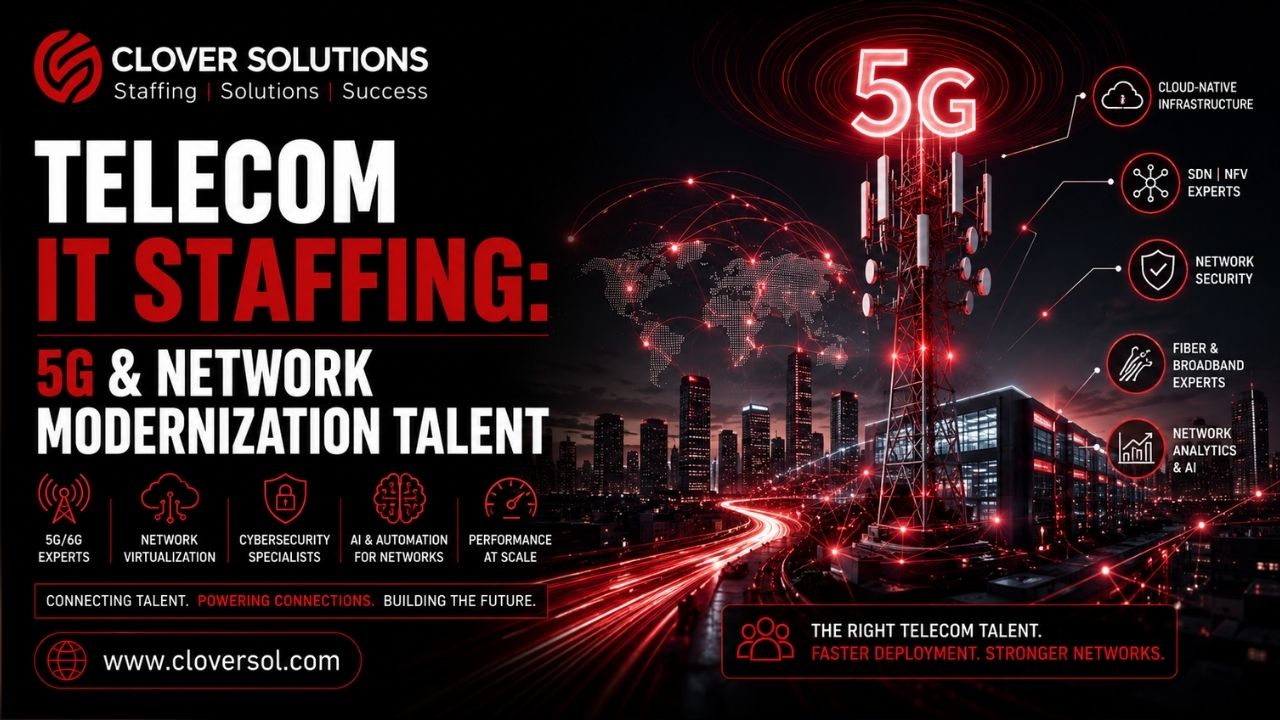
Telecom IT Staffing: Why 5G and Network Modernization Talent Is Still Hard to Find
Telecom hiring in 2026 is a study in contrasts. Furthermore, some parts of the wireless workforce — tower crews, general field technicians — have moved from acute shortage toward a more balanced, even loosening market. However, the roles at the center of 5G core buildouts, cloud-native network transformation, and telecom cybersecurity remain some of the tightest, highest-stakes hiring searches in all of IT. Consequently, a “telecom is short-staffed” or “telecom hiring has cooled” headline is usually only half true — the real picture depends entirely on which role you’re trying to fill.
The Telecom Talent Market Isn’t One Market
Recent industry data shows telecom job postings declining in some regions while the number of available field workers has increased — a real shift away from the acute wireless labor shortage that defined the peak of 5G tower and fiber deployment. Furthermore, this “talent reset” is genuinely good news for employers hiring general field and deployment roles.
But specialized software and network engineering roles tell a completely different story. Furthermore, every major U.S. carrier is running overlapping 5G and network modernization programs simultaneously — standalone core migration, Open RAN trials, BSS/OSS platform replacements, cloud-native network function deployment — and the engineers who’ve actually shipped this kind of work sit at a genuinely small number of firms nationwide, many of them already under contract elsewhere. Consequently, senior 5G core and BSS architect compensation has climbed into the $180,000–$245,000 base range for direct hire roles, reflecting just how scarce that specific combination of skills has become.
Where the Real Telecom Talent Gap Is Concentrated
5G core and RAN engineering. 5G isn’t one skill — a RAN engineer tuning fronthaul performance does fundamentally different work than a core engineer standing up a standalone access and mobility function. Both are in short supply, but they’re not interchangeable, and treating them as the same search slows hiring down.
Cloud-native network functions. The migration from virtual network functions running on virtual machines to cloud-native network functions running on Kubernetes is one of the defining technology programs in telecom for 2025 and 2026. Engineers who can re-architect stateful network functions into horizontally scalable, carrier-grade cloud-native microservices are among the hardest roles in the entire industry to fill.
BSS/OSS modernization. Customer information systems, order management, provisioning, mediation, and revenue assurance platforms are undergoing major replacement programs across carriers — and the engineers who’ve actually completed a comparable rip-and-replace are a small, in-demand pool.
IoT and connected platform engineering. Engineers with experience in industrial IoT, smart grid, or connected vehicle applications — increasingly relevant as telecom platforms extend into these adjacent markets — are among the most difficult profiles to find in the telecom talent market.
Telecom cybersecurity. As networks become more software-defined and cloud-native, security demand is rising sharply alongside it — the Bureau of Labor Statistics projects information security analyst employment to grow 29% from 2024 to 2034, a trend that directly affects telecom’s ability to staff network security roles.
Field Roles vs. Specialized Engineering: Two Different Hiring Problems
| Role Category | 2026 Market Condition | Hiring Approach |
|---|---|---|
| Tower crews, general field technicians | Shortage easing, moving toward balance | Standard sourcing timelines generally sufficient |
| RF and fiber specialists | Still tight — signing bonuses climbing | May need premium comp and faster process |
| 5G core / RAN engineers | Very scarce — small national pool | Consider contract specialists with prior carrier program experience |
| Cloud-native network engineers (Kubernetes/CNF) | Extremely scarce — one of the hardest roles industry-wide | Prioritize speed and be ready to compete on comp |
| BSS/OSS engineers | Scarce, concentrated in specific platforms (e.g., Netcracker, Amdocs) | Look for direct platform migration experience, not just general telecom IT |
| Telecom cybersecurity | Growing demand, tightening supply | Build security hiring into every modernization program from the start |
Why Generalist IT Staffing Struggles in Telecom
A strong general software engineer or cloud architect isn’t automatically a strong telecom hire. Furthermore, carrier-grade systems carry constraints most other industries don’t — five-nines availability requirements, sub-millisecond latency for packet processing, and regulatory obligations that don’t exist in typical enterprise IT. Consequently, telecom hiring needs a staffing partner who can evaluate whether a candidate’s cloud or software background actually translates to carrier-grade requirements, not just whether they know Kubernetes in the abstract.
Building a Telecom IT Staffing Strategy for 2026
- Segment your hiring by role type, not by “telecom” as a single category — field roles, RF/RAN specialists, cloud-native engineers, and BSS/OSS specialists all need different sourcing approaches and timelines.
- Move fast on cloud-native and 5G core roles specifically. These are the roles where the talent pool is smallest and competition from other carriers and vendors is most direct.
- Build security into every modernization program from day one, given how sharply information security demand is projected to grow relative to supply.
- Consider contract specialists for defined program phases — a 5G core migration or BSS replacement is often a bounded initiative better suited to specialized contract talent than a permanent hire made before the roadmap is settled.
How Clover Solutions Supports Telecom IT Staffing
Clover Solutions works with telecom organizations navigating 5G rollout, network modernization, and cloud-native transformation — sourcing engineers who understand both the software and the carrier-grade operational requirements that make telecom hiring fundamentally different from general enterprise IT.
Frequently Asked Questions
Q: Is there still a talent shortage in telecom in 2026? A: It depends on the role. Field and general deployment roles have moved toward a more balanced market, but specialized roles — 5G core engineering, cloud-native network functions, BSS/OSS modernization, and telecom cybersecurity — remain some of the hardest positions to fill in all of IT.
Q: What makes cloud-native network engineering roles so hard to fill in telecom? A: These roles require re-architecting carrier-grade network functions from virtual machines into Kubernetes-based microservices while still meeting five-nines availability and sub-millisecond latency requirements — a combination of cloud-native and telecom-specific expertise that very few engineers have.
Q: Should telecom companies use contract staffing for 5G and modernization projects? A: Contract and specialized project-based staffing is often well suited to these initiatives, since 5G core migrations and BSS/OSS replacements are typically bounded programs that don’t necessarily require permanent headcount before the technology roadmap is finalized.
Q: How is cybersecurity demand changing in telecom specifically? A: The Bureau of Labor Statistics projects information security analyst employment to grow 29% from 2024 to 2034, and as telecom networks become more software-defined and cloud-native, that growth in demand directly affects how carriers staff network security roles.
Q: Does Clover Solutions have experience with 5G and network modernization staffing? A: Yes. Clover Solutions works within the telecom vertical to source engineers for 5G, network modernization, and cloud-native transformation programs, screening for both technical depth and carrier-grade operational understanding.
Running a 5G, BSS/OSS, or network modernization program and need specialized talent? Contact Clover Solutions to talk through your telecom staffing needs.


