

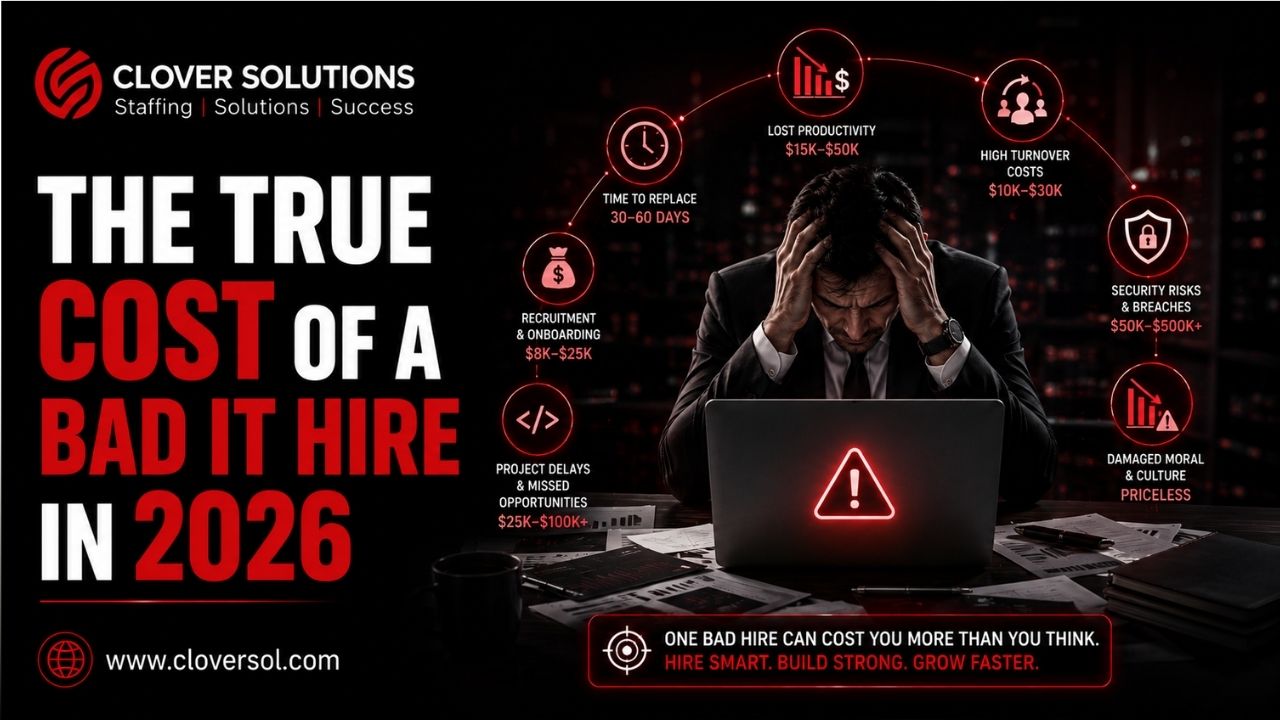
The True Cost of a Bad IT Hire in 2026 (and How Staffing Agencies Prevent It)
A mis-hire in IT rarely shows up as a single line item on a budget. Furthermore, it shows up as a missed deadline, a security gap nobody caught, a project that has to be re-scoped three months in, and a team quietly picking up the slack. Consequently, by the time leadership notices, the real cost is already much higher than anyone planned for — and the data backs this up.
What the Data Actually Says
The U.S. Department of Labor estimates that a bad hire costs at least 30% of that employee’s first-year earnings as a conservative baseline. Furthermore, the Society for Human Resource Management (SHRM) puts the full replacement cost considerably higher — estimating that replacing an employee can run anywhere from 50% to 200% of their annual salary once recruiting, onboarding, training, and lost productivity are factored in. Additionally, SHRM’s benchmarking data puts the average cost-per-hire in the US in the range of roughly $4,700 to $5,500 for recruiting alone — before any of the downstream costs of a bad fit are even counted.
For a mid-level IT hire earning $100,000 a year, that puts the realistic cost of a bad hire — direct and indirect combined — anywhere from $30,000 well into six figures, depending on seniority and how long the mismatch goes undetected.
Where the Cost Actually Comes From
Direct costs are the obvious ones: salary or contract fees paid during the mis-hire’s tenure, recruiting costs to replace them, and severance or termination costs if applicable.
Productivity costs are less visible but often larger. A struggling hire doesn’t just fail to contribute — they consume the time of the people training, correcting, and covering for them. Furthermore, on a technical team, this can stall an entire project rather than just one person’s individual output.
Rework costs are specific to IT. Bad code, poor architecture decisions, or misconfigured systems don’t just disappear when the person leaves — someone has to find the problems and fix them, often at a point where the issues are more deeply embedded and more expensive to unwind.
Opportunity costs are the hardest to quantify but arguably the most damaging: the project that didn’t ship on time, the client deliverable that slipped, the competitive window that closed while your team was managing a hiring problem instead of building.
Team morale costs compound the above. Skilled team members who repeatedly cover for underperforming hires disengage — and in a tight technical talent market, disengaged senior staff are a flight risk you can’t easily replace.
Cost of a Bad Hire: Quick Reference
| Cost Category | Source / Basis | What It Covers |
|---|---|---|
| Baseline direct cost | U.S. Department of Labor | At least 30% of first-year salary |
| Full replacement cost | SHRM | 50%–200% of annual salary |
| Average recruiting cost-per-hire | SHRM benchmarking | Roughly $4,700–$5,500 |
| Productivity, rework, morale | Not separately quantified — varies by role | Often the largest hidden cost, especially in technical roles |
Why IT Roles Are Especially High-Risk for Mis-Hires
Technical roles are harder to evaluate accurately in a standard interview process than most other positions. Furthermore, a candidate can talk convincingly about a technology stack without having the depth to actually deliver in it, and generalist interviewers often lack the specific technical background to catch the gap. Consequently, that mismatch is exactly what specialized technical vetting is designed to catch — and it’s exactly what generalist HR processes tend to miss.
How a Specialized Staffing Partner Reduces This Risk
- Technical screening by people who understand the stack. A recruiter who’s placed dozens of cloud engineers knows what to probe for beyond the resume.
- Reference checks focused on the right signals. Not just “were they reliable,” but “could they actually deliver in a comparable environment.”
- Industry-specific vetting. A healthcare IT hire and a retail IT hire need different domain knowledge — a specialist partner screens for the right one.
- Contract-to-hire options. Working with someone for a defined trial period before converting them to permanent headcount removes much of the guesswork before you’re financially committed.
- Faster replacement if it doesn’t work out. A staffing partner with a real bench and a clear replacement process shortens the window between “this isn’t working” and “we have someone better in place.”
The Bottom Line
The cost of a careful, well-vetted hiring process is visible upfront — a staffing fee, a slightly longer search. Furthermore, the cost of a bad hire is invisible upfront and expensive after the fact, as the DOL and SHRM data both confirm. Consequently, businesses that treat technical staffing as a specialized function, rather than a generalist HR task, consistently avoid the larger, hidden costs.
How Clover Solutions Reduces Mis-Hire Risk
Clover Solutions built its process specifically around this problem: a rigorous methodology of research, evaluation, and strategic decision-making at the screening stage, backed by ISO 9001:2015-certified quality processes, so the vetting happens before a candidate ever reaches your team — not after a bad fit becomes your problem to manage.
Frequently Asked Questions
Q: How much does a bad IT hire actually cost a company? A: According to the U.S. Department of Labor, a bad hire costs at least 30% of that employee’s first-year salary as a conservative estimate. SHRM puts the fuller replacement cost — including recruiting, onboarding, and lost productivity — between 50% and 200% of annual salary, depending on seniority and role complexity.
Q: Why are bad hires more expensive in IT specifically? A: Technical roles are harder to evaluate in a standard interview, which increases the risk of a mismatch. Furthermore, the downstream cost of a bad technical hire often includes rework — fixing bad code or misconfigured systems — which is a cost category most non-technical roles don’t carry.
Q: Can contract-to-hire reduce the risk of a bad hire? A: Yes. A defined trial period allows both the employer and the candidate to confirm fit before converting to permanent headcount, which significantly reduces the financial exposure of a full-time mis-hire.
Q: What should I ask a staffing agency about their vetting process? A: Ask for specifics: what technical assessments they use, how they check references, and whether their recruiters have direct experience in your industry. Vague answers are a warning sign.
Q: How does Clover Solutions screen candidates to prevent mis-hires? A: Clover Solutions uses a structured, ISO 9001:2015-certified process covering research, technical evaluation, and strategic decision-making at the screening stage — before a candidate is ever presented to a client.
Want to see how our screening process works before your next IT hire? Talk to Clover Solutions about your open role.


