

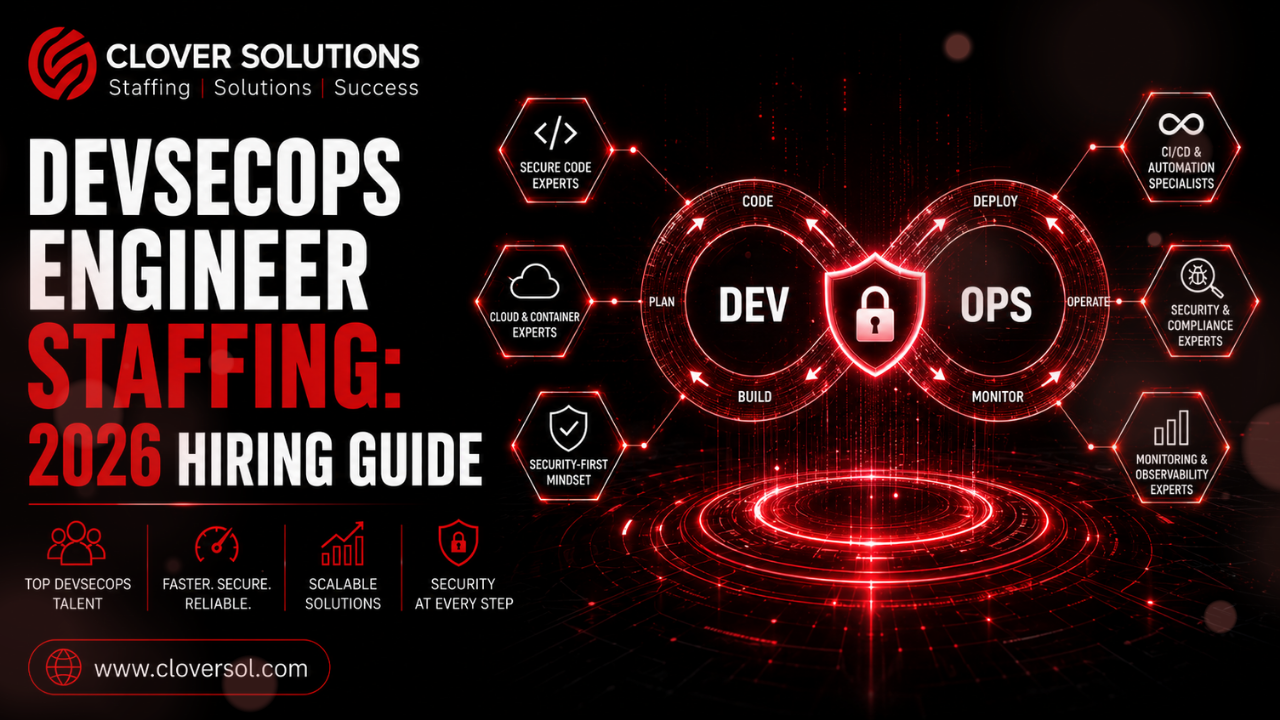
DevSecOps Engineer Staffing: A 2026 Hiring Guide
Five years ago, “DevSecOps” barely existed as a job title. Today, it’s one of the fastest-growing and hardest-to-fill requisitions in technology hiring. Furthermore, the role sits at the intersection of two disciplines that were already competitive to hire for on their own DevOps and cybersecurity which means the talent pool is genuinely thin, and the hiring mistakes are genuinely expensive.
Why DevSecOps Is Its Own Hiring Category, Not a DevOps Variant
A DevSecOps engineer embeds security into every stage of the software delivery pipeline, so vulnerabilities get caught while code is being written, not weeks after it ships. This is fundamentally different from hiring a general DevOps engineer and hoping they pick up security along the way. Furthermore, the U.S. Bureau of Labor Statistics projects information security analyst employment to grow roughly 29-32% over the coming decade far outpacing average job growth across all occupations and DevSecOps sits inside that same demand curve, but with an even smaller qualified pool because it requires depth in both disciplines simultaneously.
Why Salary Data for This Role Is Genuinely Confusing
If you’ve researched DevSecOps compensation, you’ve likely seen wildly different numbers from different sources some reporting averages near $100,000, others north of $180,000, for what appears to be the same job title. This isn’t a data error. It reflects real segmentation in the market: junior versus senior practitioners, cloud-native SaaS versus regulated industries, and cleared defense roles versus commercial ones, all counted together under one job title by aggregators that don’t distinguish between them.
A more useful way to think about it is by segment:
| Segment | Typical Base Range | Notes |
|---|---|---|
| Junior / entry-level | $90,000 – $130,000 | Focused on implementing existing security tooling in pipelines |
| Mid-level | $120,000 – $160,000 | Owns pipeline security for one or more product teams |
| Senior | $155,000 – $215,000+ | Defines organization-wide standards, often clears $200K+ total comp |
| Regulated industries (finance, healthcare, defense) | Often 15-25% above commercial equivalents | Thin candidate pool with real compliance experience drives the premium |
DevSecOps roles generally command a premium of roughly 15-40% over equivalent general DevOps positions at the same seniority level, depending on the source and specific skill stack — a range wide enough that it’s worth benchmarking against current data before finalizing a comp band, not relying on a number from even a year ago.
What’s Driving Demand Right Now
Regulatory pressure is a real driver, not just a talking point. Public company cybersecurity disclosure requirements that came into force in recent years mean material security incidents now have to be disclosed within days and the audit trail behind that disclosure runs directly through whoever owns the security pipeline. Consequently, this has shifted DevSecOps from a “nice to have” hire to something leadership increasingly treats as a compliance floor.
“Shift left” is now baked into hiring requirements, not just a buzzword. Companies increasingly expect security checks SAST, DAST, container scanning, secrets management, policy-as-code — built into the pipeline from the start, rather than bolted on before a release. Engineers who’ve actually owned this end-to-end are a genuinely small slice of the broader DevOps talent pool.
AI infrastructure is adding a new automation layer to secure. As companies deploy more machine learning infrastructure, the attack surface for pipeline and infrastructure security is expanding right alongside it, adding another dimension to what a strong DevSecOps hire needs to understand.
The Hiring Mistake That Costs the Most
A common and expensive mistake is hiring the wrong specialist for the actual problem. A role titled “DevSecOps Engineer” can mean an application security specialist who reviews code for vulnerabilities, or a cloud security engineer who secures infrastructure and cloud posture two genuinely different skill sets that don’t fully overlap. Hiring the wrong one for the actual gap means paying for a specialist who’s overqualified for the wrong problem, while the real issue often a cloud infrastructure security gap stays unresolved for months while a second search gets started. Getting specific about which of these your organization actually needs, before the job posting goes out, avoids this entirely.
What to Screen For in a Real DevSecOps Candidate
- Ownership, not familiarity. “Familiar with Jenkins” and “owned a pipeline running 50 deployments a day and debugged production failures” describe very different candidates. Screen for the second.
- Container security depth. Real experience with image scanning tools, runtime security, and a clear point of view on base image and configuration choices not just theoretical knowledge.
- Policy-as-code experience. Tools like Open Policy Agent, Kyverno, or Conftest, with security policies checked into version control rather than enforced manually.
- Cloud platform fluency, ideally across more than one provider. Given how much of modern DevSecOps work sits on cloud infrastructure, multi-cloud experience is an increasingly valuable differentiator.
How to Staff for DevSecOps Effectively
- Name the specific gap before writing the job description. “Application security” and “cloud security posture” are different searches, even under the same job title.
- Benchmark compensation against current data, not last year’s numbers. Given how quickly this market has moved, a comp band that was competitive twelve months ago may already be behind.
- Consider contract specialists for urgent gaps. Given how thin the qualified pool is, a contract engineer who can address an immediate security gap while a permanent search runs in parallel often prevents costly delays.
- Don’t require the impossible candidate. Job postings demanding deep expertise across every cloud platform, every scanning tool, and a decade of experience simultaneously routinely stall — narrowing the true must-have requirements to a focused shortlist usually moves the search faster, not slower.
How Clover Solutions Supports DevSecOps Staffing
Clover Solutions sources DevSecOps and platform security engineers for clients navigating exactly this hiring complexity — helping define the specific gap being filled, benchmarking compensation against current market data, and screening for demonstrated pipeline ownership rather than tool familiarity alone.
Frequently Asked Questions
Q: What does a DevSecOps engineer actually do? A: A DevSecOps engineer embeds security practices — including automated scanning, secrets management, and policy-as-code — directly into the software delivery pipeline, so vulnerabilities are caught during development rather than after deployment.
Q: Why is DevSecOps salary data so inconsistent across sources? A: Different sources often blend junior and senior practitioners, commercial and regulated-industry roles, and cleared and non-cleared positions under one job title, producing very different averages depending on which population a given source is actually measuring.
Q: What’s the difference between a DevSecOps engineer and a general DevOps engineer? A: A general DevOps engineer focuses on build, deployment, and infrastructure automation. A DevSecOps engineer adds deep security integration — vulnerability scanning, secrets management, and compliance automation — built into that same pipeline, which is a genuinely distinct and less common skill combination.
Q: Should companies hire DevSecOps engineers on contract or full-time? A: It depends on the need. Given how thin the qualified talent pool is, contract specialists can often address an urgent security gap faster than a full permanent search, while a parallel search for a permanent hire continues.
Q: Does Clover Solutions staff for DevSecOps and platform security roles? A: Yes. Clover Solutions sources DevSecOps and platform security engineers, helping clients define the specific technical gap they’re hiring for and screening for demonstrated pipeline ownership experience.
Struggling to fill a DevSecOps role, or not sure which specific skill set you actually need? Contact Clover Solutions to talk through your engineering staffing plan.


