

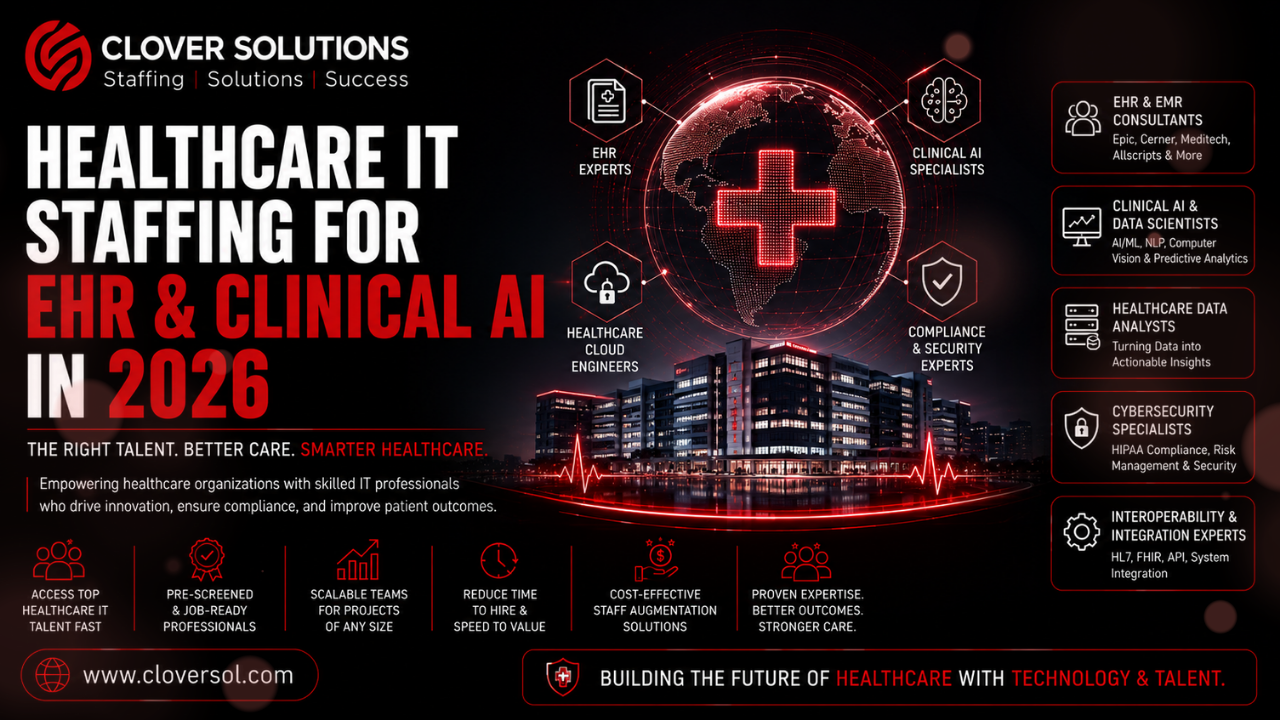
Healthcare IT Staffing for EHR Upgrades and Clinical AI in 2026
Healthcare technology in 2026 is being reshaped by two forces at once. First, core EHR platforms keep modernizing. Second, AI is getting embedded directly into clinical workflows, faster than most organizations can staff for it. Epic alone now holds more than 40% of the hospital EHR market in the US. Furthermore, the company has said its 2026 roadmap centers on weaving AI tools directly into clinical, administrative, and patient-facing workflows. Consequently, for healthcare organizations, the staffing conversation has expanded well beyond general HIPAA compliance. It now includes a specific, fast-evolving set of EHR, interoperability, and clinical AI roles.
Why This Is a Different Staffing Challenge Than General Healthcare IT
Healthcare IT staffing broadly covers compliance and infrastructure. However, this is a narrower, more specialized layer: the people who actually configure, optimize, and extend the EHR systems clinicians use every day. Increasingly, it also includes the AI tools layered on top of those systems. The global EHR market is projected to reach $47.7 billion by 2027, driven largely by ongoing modernization and migration projects. Each of those projects, in turn, depends on finding specialists most healthcare organizations don’t keep on staff year-round.
The Roles Driving Demand in 2026
EHR analysts and trainers. Application analysts configure and support specific EHR modules — Epic, Oracle Cerner, MEDITECH. This remains the most common entry point into healthcare IT, and demand for experienced analysts stays high through every implementation, upgrade, and optimization cycle.
HL7/FHIR integration engineers. FHIR has become the de facto API standard for healthcare data exchange, enabling e-prescribing, prior authorization, and population health data sharing across systems. Consequently, engineers who can build and maintain these integrations are increasingly essential as interoperability shifts from a compliance checkbox to core infrastructure.
Clinical informaticists. These professionals bridge IT and care delivery directly, translating clinical workflow needs into system-level requirements. This role has become more valuable as AI tools get embedded deeper into day-to-day clinical work.
Healthcare AI/ML engineers and analysts. The technical bar here is specific: Python and a deep-learning framework, FHIR R4 and HL7 v2 fluency, and familiarity with at least one clinical vocabulary — SNOMED CT, ICD-10, RxNorm, or LOINC. Add practical experience with HIPAA-aligned cloud platforms like AWS HealthLake, Azure Health Data Services, or Google Cloud Healthcare API, and that’s the baseline. Beyond that, candidates who can describe a concrete interoperability project stand out clearly from the rest of the field. Saying “I know FHIR” isn’t enough — naming a specific integration shipped against Epic, Oracle Health, or athenahealth is what actually separates strong candidates.
Healthcare cybersecurity analysts. As AI and interoperability expand the volume of data moving between systems, healthcare remains the most targeted sector for cyberattacks. Indeed, the average healthcare data breach now costs $10.93 million — the highest of any industry for the thirteenth consecutive year.
Healthcare IT Salary Benchmarks (2026)
| Role | Typical Salary Range |
|---|---|
| Senior EHR Application Analyst | $90,000 – $130,000 |
| EHR Module Lead (Inpatient, Ambulatory, Revenue Cycle) | $100,000 – $145,000 |
| Healthcare IT Project Manager | $95,000 – $140,000 |
| Clinical Informaticist | $95,000 – $140,000 |
| Healthcare Cybersecurity Analyst | $100,000 – $150,000 |
| Director of Clinical Informatics | $160,000 – $240,000 |
| EHR Implementation Director | $180,000 – $280,000 |
Why Timing Matters More in Healthcare IT Staffing
Healthcare organizations that wait until an EHR upgrade is already underway to start staffing consistently run into the same problems: fewer qualified candidates available, longer hiring timelines, and more competition for the same specialists. In fact, experienced professionals across Epic, Oracle Health, and MEDITECH are often engaged on projects months before implementation actually begins. Therefore, starting the staffing conversation early provides access to a meaningfully stronger candidate pool than starting once the project is already behind schedule.
Onboarding speed matters too. With a mature, documented process for provisioning contractor access under HIPAA-compliant security controls, organizations can move a new hire from contract signing to productive work in 8-10 business days. Without that playbook, however, 3-4 week delays from access provisioning bottlenecks are common — a meaningful setback on a project timeline that was already tight.
Why Interoperability Has Changed What Healthcare IT Hiring Looks Like
Healthcare IT roles used to be more siloed. A professional could specialize deeply in EHR configuration, or reporting, or infrastructure, without needing to understand how those systems connected to anything else. But interoperability has changed that. Today’s environment increasingly requires professionals who understand how data flows between systems, departments, and external partners, not just within a single platform. As a result, traditional job descriptions often no longer reflect what the role actually requires. Organizations that don’t expand how they define qualifications risk missing genuinely qualified candidates.
How to Build a Healthcare IT Staffing Plan for 2026
- Start staffing conversations months before a project begins, not once the implementation is already underway.
- Look beyond platform certification alone. The strongest EHR and interoperability candidates can describe specific, shipped integration work — not just familiarity with a standard.
- Build a documented onboarding playbook for contractor access. After all, the difference between 8-10 days and 3-4 weeks of onboarding delay is almost entirely about process maturity, not candidate quality.
- Treat AI-adjacent roles as a distinct specialization, not a subset of general EHR analyst work. The skill stack — Python, deep learning, clinical vocabularies, HIPAA-aligned cloud — is genuinely different.
How Clover Solutions Supports Healthcare IT Staffing
Clover Solutions sources EHR analysts, HL7/FHIR integration engineers, clinical informaticists, and healthcare AI talent for organizations navigating EHR upgrades, interoperability initiatives, and clinical AI adoption. Our screening is built around real, demonstrated implementation experience, not certifications alone.
Frequently Asked Questions
Q: What roles are most in demand for healthcare IT staffing in 2026? A: EHR analysts and trainers (particularly Epic and Oracle Cerner), HL7/FHIR integration engineers, clinical informaticists, healthcare AI/ML engineers, and healthcare cybersecurity analysts are among the highest-demand roles as EHR modernization and clinical AI adoption both accelerate.
Q: Why does FHIR matter for healthcare IT hiring? A: FHIR (Fast Healthcare Interoperability Resources) has become the de facto API standard for healthcare data exchange, enabling e-prescribing, prior authorization, and population health data sharing. As a result, engineers with genuine FHIR integration experience are increasingly essential as interoperability becomes core infrastructure rather than a compliance requirement.
Q: When should a healthcare organization start staffing for an EHR upgrade? A: Ideally months before implementation begins. Organizations that wait until a project is already underway consistently find fewer qualified candidates, longer hiring timelines, and more competition for the specialists they need.
Q: What skills do healthcare AI roles require beyond general data science? A: The technical floor typically includes Python and a deep-learning framework, FHIR R4 and HL7 v2 fluency, familiarity with a clinical vocabulary like SNOMED CT or ICD-10, and practical experience with HIPAA-aligned cloud platforms such as AWS HealthLake or Azure Health Data Services.
Q: Does Clover Solutions staff for EHR and interoperability projects specifically? A: Yes. Clover Solutions sources EHR analysts, FHIR/HL7 integration engineers, clinical informaticists, and healthcare AI talent, screening for demonstrated implementation experience with platforms like Epic, Oracle Health, and MEDITECH.
Planning an EHR upgrade or clinical AI initiative? Contact Clover Solutions to start staffing before the project timeline gets tight.


