

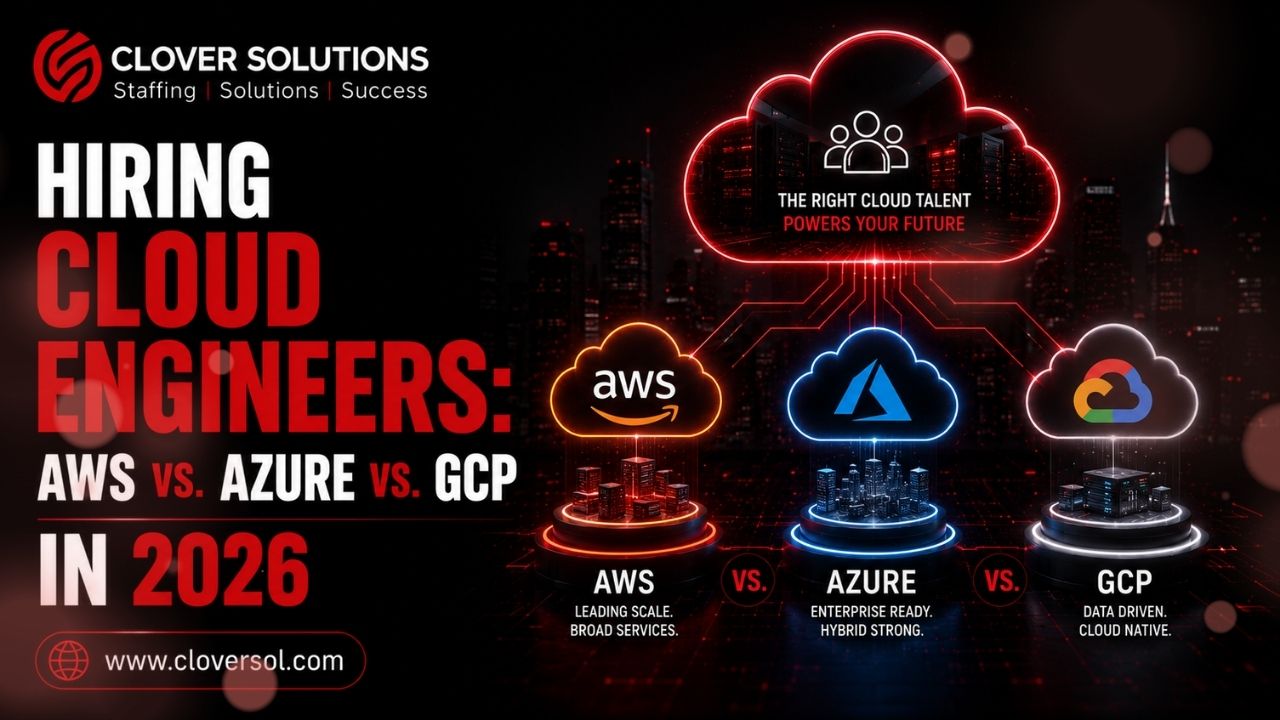
Hiring Cloud Engineers in 2026: AWS vs. Azure vs. GCP Talent Pools Explained
Cloud computing stopped being a “nice to have” skill years ago — it’s now the basic infrastructure nearly every digital business runs on. Furthermore, that shift has created one of the most persistent hiring gaps in all of IT. Roughly 60% of organizations expect cloud talent shortages to intensify through 2026, and more than 90% of organizations report facing IT skills shortages overall. Consequently, hiring cloud talent effectively in 2026 requires understanding not just “cloud” as a category, but the real differences between the AWS, Azure, and GCP talent pools you’re actually recruiting from.
Why Cloud Hiring Has Gotten Harder, Not Easier
Cloud roles in 2026 no longer just mean “keep the servers running.” Furthermore, they now sit at the intersection of infrastructure, security, AI, and software delivery — which means the bar for a genuinely qualified candidate has risen sharply even as demand keeps climbing. The U.S. Bureau of Labor Statistics projects strong continued growth in computer and IT employment through the rest of the decade, with cloud-specific roles growing even faster than the broader IT category. Additionally, cloud engineer compensation has been climbing at a notably faster rate than most other IT specializations, which is a direct market signal of how tight this talent pool has become.
AWS, Azure, and GCP: Not the Same Talent Pool
AWS has the largest and deepest talent pool of the three platforms, reflecting its position as the most widely adopted cloud provider. If your organization needs to fill cloud roles quickly and at scale, AWS-focused hiring will generally give you the largest candidate pool to draw from.
Azure talent is concentrated heavily in enterprise environments, particularly organizations with existing Microsoft infrastructure — finance, healthcare, and government sectors lean toward Azure more than the broader market. If your organization already runs on Microsoft’s ecosystem, Azure-specific experience is a meaningfully different (and often smaller) search than a general cloud search.
GCP has by far the smallest certified talent pool of the three major platforms. However, the engineers who do specialize in GCP tend to concentrate around data engineering, analytics infrastructure, and machine learning platforms — meaning a GCP search is really a data/AI-adjacent search more than a general infrastructure search, and it typically commands a premium because the pool is smaller.
Cloud Platform Hiring at a Glance
| Platform | Talent Pool Size | Strongest Candidate Concentration | Hiring Implication |
|---|---|---|---|
| AWS | Largest | General infrastructure, broad enterprise use | Fastest to fill at scale |
| Azure | Mid-sized | Enterprise, Microsoft-integrated environments | Best fit if you’re already a Microsoft shop |
| GCP | Smallest | Data engineering, analytics, machine learning | Smaller, pricier pool — often a data-adjacent hire |
The Skills That Separate Real Candidates From Certification Collectors
A common hiring frustration in 2026 is reviewing a flood of nearly identical resumes — a foundational certification, a portfolio of tutorial projects, and no evidence of solving real problems under real constraints. Furthermore, the candidates who stand out and get hired tend to show depth in areas certifications alone don’t capture:
- Infrastructure as Code — genuine experience with Terraform (now close to table stakes) and ideally a second tool like Pulumi or CloudFormation
- CI/CD pipeline design — not just using a pipeline someone else built, but designing one for cloud-native applications
- Security automation — IAM policy design, secrets management, and compliance-as-code, not just theoretical security awareness
- Multi-cloud fluency — increasingly, large enterprises run different workloads on different platforms simultaneously, and engineers who can move between them without a second hire are especially valuable
Cloud Security: The Fastest-Growing Niche Within Cloud
Cloud security has become one of the most acute skill shortages within the broader cloud talent gap, trailing only general AI and cloud architecture skills in overall scarcity according to recent technology hiring reports. Furthermore, as regulatory requirements tighten and cloud spending grows, security-focused cloud engineers are increasingly treated as a distinct, premium hiring category rather than a subset of general cloud roles.
How to Staff Cloud Roles Effectively in 2026
- Match the platform to the actual environment, not the platform that’s easiest to find candidates for. Hiring an AWS specialist into a primarily Azure environment creates a ramp-up problem you didn’t need to have.
- Don’t rely on certifications alone as a screen. Certifications indicate baseline knowledge; real infrastructure-as-code, CI/CD, and security automation experience indicate actual capability.
- Consider contract or contract-to-hire for GCP-specific and security-specific roles, given how much smaller and more expensive those talent pools are — a flexible engagement can get you access faster than a lengthy permanent search.
- Think multi-cloud when scoping senior roles. Given how common multi-platform environments have become at scale, senior cloud hires increasingly need fluency across more than one provider.
How Clover Solutions Supports Cloud Technology Staffing
Clover Solutions sources cloud engineers, architects, DevOps specialists, and cloud security professionals across AWS, Azure, and GCP, screening specifically for infrastructure-as-code depth, CI/CD design experience, and security automation skill — not just certification checklists.
Frequently Asked Questions
Q: Which cloud platform has the largest talent pool — AWS, Azure, or GCP? A: AWS has the largest and deepest overall talent pool, reflecting its position as the most widely adopted cloud provider. Azure’s pool is concentrated in enterprise and Microsoft-integrated environments, while GCP has the smallest pool, concentrated around data and machine learning specialists.
Q: Why is GCP cloud talent harder to find and more expensive? A: GCP has a significantly smaller certified professional pool than AWS or Azure. The engineers who do specialize in GCP tend to concentrate in data engineering and machine learning, which makes GCP hiring effectively a data-adjacent search with less overall supply.
Q: What skills matter most when hiring cloud engineers in 2026? A: Beyond baseline certifications, the strongest candidates typically show real depth in infrastructure as code (particularly Terraform), CI/CD pipeline design for cloud-native applications, and security automation — skills that separate genuinely capable engineers from certification-only candidates.
Q: Is cloud security a separate hiring category from general cloud engineering? A: Increasingly, yes. Cloud security has become one of the fastest-growing and most acute talent shortages within the broader cloud category, and organizations increasingly hire for it as a distinct specialization rather than treating it as a general cloud engineer’s side responsibility.
Q: Does Clover Solutions staff for multi-cloud environments? A: Yes. Clover Solutions sources cloud talent across AWS, Azure, and GCP and can support both single-platform and multi-cloud staffing needs depending on your environment.
Building out your cloud team and not sure which platform expertise you actually need? Contact Clover Solutions to talk through your cloud staffing plan.


