

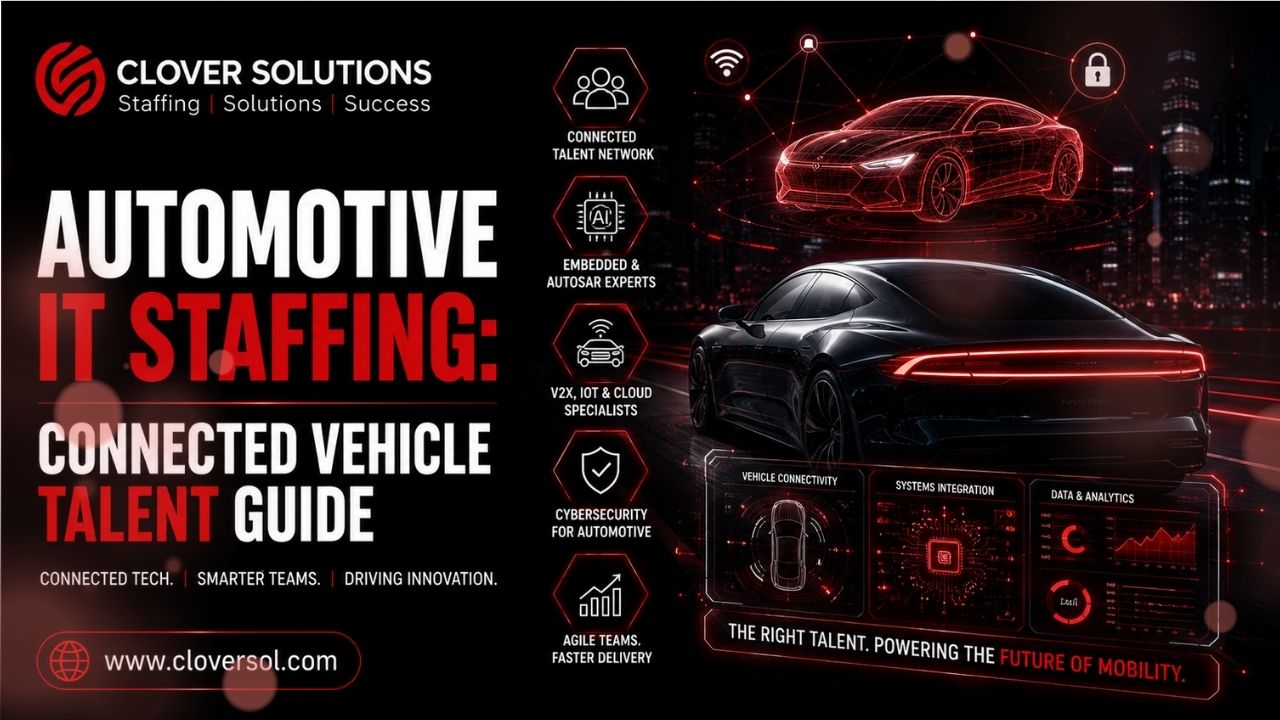
Automotive IT Staffing: Hiring for Connected Vehicles and Embedded Software
The automotive industry isn’t just building cars anymore — it’s building distributed software products that happen to have wheels. Furthermore, a modern vehicle now spans embedded control systems, cloud connectivity, mobile apps, over-the-air updates, and increasingly, AI-driven driver assistance. Consequently, the talent an automotive company needs today looks a lot more like a technology company’s hiring list than a traditional manufacturer’s — and most automotive organizations are struggling to keep up.
Why Automotive IT Staffing Has Gotten So Much Harder
The shift toward electrification, connected vehicles, and software-defined architectures has fundamentally changed what “automotive engineering” means. Furthermore, industry research points to a US automotive talent shortfall in the range of 150,000 skilled professionals, concentrated heavily in engineering and data science roles, driven by the rapid integration of electric and autonomous vehicle technology. Additionally, cybersecurity roles within the automotive sector are seeing vacancy rates as high as 25%, as the industry grapples with the security risks that come with permanently connected vehicles.
This isn’t a temporary hiring crunch. It reflects a structural shift: automakers and suppliers are now competing directly with technology companies for the same software engineers, cloud architects, and AI specialists — talent that historically had no reason to consider the automotive sector at all.
Where the Gap Is Concentrated
Embedded software engineering. Vehicle control systems, powertrain software, and safety-critical systems still require deep embedded expertise — a skill set that’s in short supply industry-wide and doesn’t transfer cleanly from general software backgrounds.
Connected vehicle and cloud platforms. Telematics, over-the-air update systems, and infotainment platforms increasingly run on cloud infrastructure that looks more like a SaaS product than traditional automotive electronics — requiring engineers comfortable moving between the vehicle, the edge, and the cloud.
ADAS and autonomous systems. Advanced driver-assistance systems depend on engineers who can work with sensor fusion, real-time processing, and safety certification requirements simultaneously — a genuinely rare combination of skills.
Automotive cybersecurity. A permanently connected vehicle is a permanently exposed attack surface. Furthermore, cybersecurity specialists who understand automotive-specific frameworks (like ISO/SAE 21434) are significantly harder to find than general application security engineers.
Data and AI engineering. Demand for data and AI professionals in automotive is projected to keep climbing sharply as companies lean on data analytics for both product development and operational efficiency.
Automotive Tech Roles: What They Actually Require
| Role | Core Skill Set | Why It’s Hard to Fill |
|---|---|---|
| Embedded software engineer | C/C++, RTOS, safety-critical systems | Deep specialization, doesn’t transfer from general software roles |
| Connected vehicle / cloud engineer | Cloud architecture, telematics, OTA systems | Requires both automotive context and modern cloud fluency |
| ADAS engineer | Sensor fusion, real-time systems, safety certification | Narrow talent pool, high safety stakes |
| Automotive cybersecurity engineer | ISO/SAE 21434, connected systems security | Automotive-specific frameworks aren’t taught in general security training |
| Automotive data/AI engineer | ML pipelines, vehicle data platforms | Competing directly with tech-sector AI hiring budgets |
Why Generalist Tech Staffing Falls Short in Automotive
A candidate can be an excellent general software engineer and still be the wrong fit for automotive work. Furthermore, automotive software carries asymmetric risk that most other industries don’t: a bug in a typical consumer app might hurt conversion rates, but a bug in vehicle software can affect safety, regulatory compliance, and brand trust simultaneously. Consequently, automotive hiring needs to screen not just for coding ability, but for judgment around safety-critical systems, long product lifecycles, and compliance requirements — context a generalist tech recruiter usually isn’t equipped to evaluate.
How to Build an Automotive Tech Hiring Strategy That Actually Works
- Don’t wait for the perfect background. Given how new software-defined vehicle roles are, some of the strongest candidates will come from adjacent industries (aerospace, industrial IoT, general cloud engineering) rather than automotive-native backgrounds.
- Separate safety-critical roles from general software roles in your screening. Embedded and ADAS roles need different vetting rigor than a cloud platform or mobile app role.
- Build flexible engagement models into your plan. Given how scarce and expensive senior automotive software talent has become, contract and contract-to-hire arrangements let you access specialized skills for a defined program phase without committing to permanent headcount before the roadmap is settled.
- Move fast. In a market with reported demand-to-supply ratios as high as 10:1 for critical automotive tech roles in some regions, a slow hiring process loses candidates to competitors — including non-automotive tech companies — before you ever get to an offer.
How Clover Solutions Supports Automotive IT Staffing
Clover Solutions works with automotive organizations navigating exactly this shift — sourcing engineers who can bridge traditional automotive engineering with modern embedded, cloud, and connected-vehicle software requirements. Furthermore, our screening process is built to evaluate both the technical depth and the safety-critical judgment that automotive software roles demand, not just general coding ability.
Frequently Asked Questions
Q: Why is it so hard to hire automotive software engineers right now? A: The shift toward electrification, connected vehicles, and software-defined architectures means automakers are now competing directly with technology companies for the same software, cloud, and AI talent — a structural shift the traditional automotive talent pipeline hasn’t caught up to.
Q: What’s the difference between embedded software roles and general software roles in automotive? A: Embedded roles involve safety-critical, real-time systems running directly on vehicle hardware, requiring specialized skills like RTOS and low-level C/C++ development. General software roles — cloud platforms, mobile apps, telematics — require more conventional modern software skills applied to an automotive context.
Q: What is ISO/SAE 21434 and why does it matter for automotive cybersecurity hiring? A: ISO/SAE 21434 is an automotive-specific cybersecurity engineering standard. Candidates familiar with it understand how to build security into connected vehicle systems from the design stage, which general application security experience doesn’t necessarily cover.
Q: Should automotive companies use contract staffing for software roles? A: Contract and contract-to-hire arrangements are increasingly useful in automotive software hiring, since they allow companies to bring in scarce, specialized talent for a specific program phase without committing to permanent headcount before long-term technology roadmaps are finalized.
Q: Does Clover Solutions have experience staffing for connected vehicle and embedded software roles? A: Yes. Clover Solutions works within the automotive vertical to source engineers who understand both traditional automotive engineering constraints and modern embedded, cloud, and connected-vehicle software requirements.
Building out a connected vehicle or embedded software team? Contact Clover Solutions to talk through your automotive IT staffing needs.


