

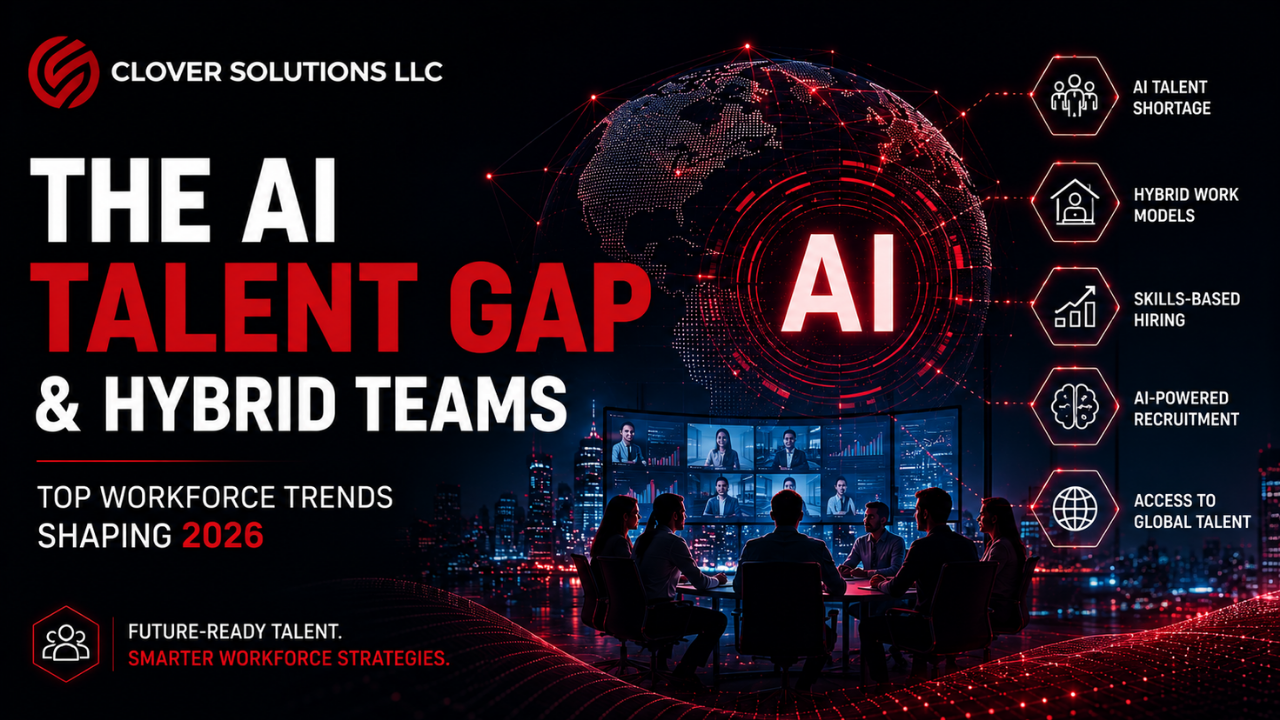
The AI Talent Gap and Hybrid Teams: How Businesses Are Reshaping Workforce Strategies in 2025
Artificial Intelligence is no longer a future technology—it is rapidly becoming the foundation of modern business operations. Organizations across industries are integrating AI into customer service, software development, cybersecurity, data analytics, cloud operations, and business automation.
However, while AI adoption continues to accelerate, companies are facing a major challenge: a growing AI talent gap.
The demand for AI and Machine Learning professionals has surged dramatically over the last few years, creating fierce competition for skilled talent. At the same time, businesses are increasingly embracing hybrid AI-human workforce models that combine intelligent automation with human expertise.
As a result, entirely new job categories are emerging, including Prompt Engineers, AI Solution Integrators, Automation Engineers, AI Operations Specialists, and AI Governance Experts.
For businesses seeking to remain competitive, understanding these workforce shifts is becoming essential.
What Is the AI Talent Gap?
The AI talent gap refers to the difference between the growing demand for AI professionals and the available supply of qualified candidates.
Organizations worldwide are investing heavily in:
- Generative AI
- Machine Learning
- Large Language Models (LLMs)
- Predictive Analytics
- AI-Powered Automation
- Computer Vision
- Natural Language Processing
Unfortunately, the talent pipeline is not growing at the same pace.
Many businesses struggle to find experienced professionals who possess both technical expertise and practical implementation experience.
This shortage is creating recruitment challenges across nearly every industry.
Why the Demand for AI Talent Is Exploding
Several factors are driving the demand for AI professionals in 2025.
1. Enterprise AI Adoption
Businesses are implementing AI solutions to:
- Automate repetitive tasks
- Improve customer experiences
- Enhance decision-making
- Increase operational efficiency
- Reduce costs
Every implementation requires skilled professionals capable of designing, deploying, and managing AI systems.
2. Generative AI Growth
The rapid adoption of generative AI platforms has created unprecedented demand for specialists who understand:
- Prompt Engineering
- AI Model Training
- LLM Optimization
- AI Workflow Automation
Companies are actively seeking professionals who can maximize the value of AI investments.
3. Digital Transformation Initiatives
Organizations continue to modernize infrastructure, migrate to the cloud, and automate business processes.
AI expertise has become a critical component of these transformation projects.
The Rise of Hybrid AI-Human Teams
One of the most important workforce trends in 2025 is the emergence of hybrid AI-human teams.
Rather than replacing employees, businesses are integrating AI tools to augment human capabilities.
In a hybrid model:
- AI handles repetitive and data-intensive tasks.
- Humans provide strategic thinking and decision-making.
- AI accelerates workflows.
- Employees focus on creativity, innovation, and relationship building.
This collaborative approach improves productivity while maintaining human oversight.
Emerging Roles Created by AI Adoption
The AI revolution is generating entirely new career opportunities.
Prompt Engineers
Prompt Engineers design and optimize prompts that help AI systems generate accurate and useful outputs.
Responsibilities include:
- Prompt design
- Workflow optimization
- AI response evaluation
- Content generation strategies
AI Solution Integrators
AI Solution Integrators bridge the gap between business objectives and AI technologies.
Their responsibilities include:
- AI implementation
- System integration
- Workflow automation
- Change management
Automation Engineers
Automation Engineers develop solutions that combine AI and traditional automation technologies.
Key areas include:
- Robotic Process Automation (RPA)
- Workflow automation
- AI orchestration
- Process optimization
AI Operations Specialists
AI systems require ongoing monitoring and maintenance.
AI Operations Specialists ensure:
- Model performance
- Compliance
- Security
- Continuous optimization
How the AI Talent Gap Impacts Businesses
Organizations that cannot secure qualified AI professionals face several challenges:
Slower Innovation
Without skilled talent, AI initiatives often stall before delivering business value.
Increased Recruitment Costs
Competition for AI professionals has significantly increased compensation expectations.
Project Delays
Many AI projects experience delays due to talent shortages.
Competitive Disadvantages
Organizations that fail to implement AI effectively risk falling behind more innovative competitors.
Strategies for Closing the AI Talent Gap
Upskilling Existing Employees
Many organizations are investing in internal training programs to develop AI capabilities among existing staff.
Partnering with Specialized Staffing Firms
Experienced staffing partners can help organizations identify and recruit qualified AI professionals faster.
At Clover Solutions, we help businesses connect with highly skilled technology professionals across:
- Artificial Intelligence
- Machine Learning
- Cloud Computing
- Data Analytics
- Cybersecurity
- DevOps
Embracing Hybrid Workforce Models
Businesses that combine AI technologies with skilled professionals often achieve better outcomes than organizations relying solely on automation.
Building AI Talent Pipelines
Long-term workforce planning helps organizations prepare for future talent demands.
Why AI Staffing Will Become Critical in 2025
As AI adoption expands, companies will increasingly rely on specialized staffing providers to secure talent.
The demand for:
- Prompt Engineers
- AI Architects
- Machine Learning Engineers
- AI Solution Integrators
- Automation Engineers
is expected to remain strong throughout the decade.
Organizations that establish AI hiring strategies today will be better positioned for future success.
How Clover Solutions Supports AI Workforce Transformation
Clover Solutions helps organizations navigate workforce transformation through specialized staffing and consulting services.
Our expertise includes:
- AI Staffing
- Technology Staffing
- Contract Staffing
- Direct Hire Recruitment
- Cloud & DevOps Recruitment
- Data Analytics Talent Acquisition
- Cybersecurity Staffing
By combining recruitment expertise with deep technology knowledge, we help businesses build future-ready teams.
Home: https://cloversol.com/
About Us: https://cloversol.com/about-us/
Contact Us: https://cloversol.com/contact-us/
Services: https://cloversol.com/services/
Conclusion
The AI talent gap is reshaping the global workforce. As organizations accelerate AI adoption, demand for specialized professionals continues to outpace supply.
The rise of hybrid AI-human teams is creating new opportunities for businesses to improve productivity while maintaining strategic human oversight.
Organizations that invest in AI talent, workforce development, and flexible staffing strategies will be best positioned to thrive in the AI-driven economy.
FAQs
What is the AI talent gap?
The AI talent gap refers to the shortage of qualified AI professionals relative to growing industry demand.
What are hybrid AI-human teams?
Hybrid teams combine AI technologies with human expertise to improve productivity and business outcomes.
Which AI roles are most in demand in 2025?
Prompt Engineers, Machine Learning Engineers, AI Solution Integrators, Automation Engineers, and AI Architects are among the fastest-growing roles.
How can businesses overcome AI talent shortages?
Organizations can upskill employees, partner with staffing experts, and adopt hybrid workforce strategies.
Call to Action
Looking to hire AI professionals or build future-ready technology teams?
Contact Clover Solutions today to discover how our staffing experts can help you find top AI, cloud, cybersecurity, and technology talent.


