

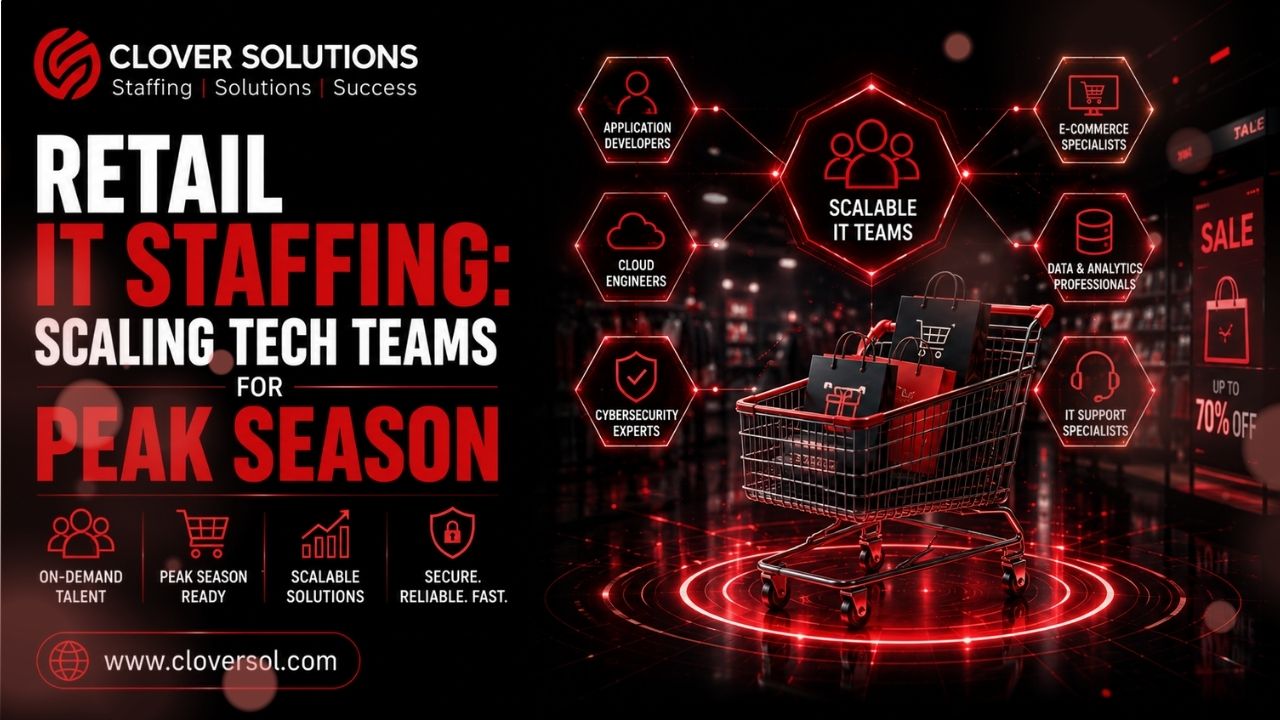
Retail IT Staffing: Scaling Tech Teams for Peak Season and Beyond
Retail runs on a technology stack that has to work every single day of the year — and then work under ten times the load during a six-week peak season window. Furthermore, unlike most industries, retail can’t treat IT staffing as a steady, predictable headcount plan. It has to be built around dramatic, predictable swings in demand — and the companies that get this wrong find out during their busiest, highest-stakes weeks of the year.
Why Retail IT Staffing Is Different
Most industries hire IT talent to support relatively steady operations. Retail is structurally different: e-commerce platforms, point-of-sale systems, inventory management, and omnichannel fulfillment all have to scale hard for peak periods — Black Friday, holiday season, back-to-school — and then scale back down. Furthermore, industry data shows more than 65% of e-commerce companies now depend on flexible staffing specifically to handle seasonal spikes, platform revamps, and automation programs, rather than trying to carry that capacity year-round.
At the same time, retail hiring overall is under real pressure. Industry research on 2026 retail recruiting points to extended time-to-hire as a defining challenge this year, with longer hiring cycles leading to higher candidate drop-off and added strain on teams trying to operate understaffed during critical periods.
The Roles That Matter Most in Retail IT
Cloud and infrastructure engineers. E-commerce platforms need to handle massive, short-term traffic surges without downtime — a core cloud scaling and reliability engineering problem.
Inventory and supply chain systems specialists. Real-time inventory accuracy across stores, warehouses, and online channels is one of the hardest ongoing technical problems in retail, and it gets dramatically harder under peak-season load.
Point-of-sale (POS) and payment systems engineers. POS uptime during peak season isn’t a nice-to-have — a system failure during a high-traffic weekend translates directly into lost revenue at the register.
Data and AI engineers. Personalization, demand forecasting, and AI-powered customer engagement tools are driving increased demand for data engineers and machine learning specialists across the retail sector.
Cybersecurity specialists. Retail handles enormous volumes of payment and customer data, particularly during peak shopping periods when transaction volume — and attacker interest — both spike.
Why Flexible Staffing Models Fit Retail Better Than Fixed Headcount
| Approach | Fixed Year-Round Headcount | Flexible / Seasonal Staffing |
|---|---|---|
| Cost during off-peak | Full cost carried year-round | Scales down with demand |
| Peak-season readiness | Risk of being understaffed at the worst time | Built specifically to scale up before peak |
| Specialized skill access | Limited to what you can justify hiring permanently | Access to niche skills (e.g., peak-load cloud engineering) for defined windows |
| Hiring speed | Full-cycle hiring process, often too slow for a seasonal need | Faster access to pre-vetted, available talent |
Common Retail IT Staffing Mistakes
- Waiting too long to start seasonal hiring. With longer average time-to-hire across the industry, starting the search a few weeks before peak season is often too late.
- Treating all roles the same. A POS uptime engineer and a personalization data scientist have very different urgency and skill requirements — a one-size-fits-all seasonal hiring plan misses this.
- Under-investing in systems, not just headcount. Retail leaders increasingly see hiring technology and automation investment as a primary lever for hiring efficiently — not a “nice to have” layered on top of more recruiters.
- Ignoring cybersecurity until after a peak-season incident. Security staffing should scale ahead of the traffic and transaction surge, not in response to it.
How to Build a Retail IT Staffing Plan That Actually Holds Up
- Forecast your peak-season technical needs 3–6 months ahead, not weeks ahead, given how much longer time-to-hire has become industry-wide.
- Separate “always-on” roles from “surge” roles. Core platform engineers may need to be permanent; peak-load cloud scaling support may be better suited to contract staffing.
- Build a repeatable seasonal staffing relationship, not a one-off scramble each year — a staffing partner who understands your systems doesn’t have to relearn your environment every peak season.
- Prioritize speed of onboarding, not just speed of sourcing — a great candidate who takes three weeks to become productive doesn’t help you in a six-week peak window.
How Clover Solutions Supports Retail IT Staffing
Clover Solutions works with retail organizations to build both always-on technical teams and flexible seasonal capacity — cloud engineers, inventory systems specialists, POS and payments engineers, data engineers, and cybersecurity talent — sourced and vetted specifically for the demands of retail’s unique operating rhythm.
Frequently Asked Questions
Q: Why does retail need a different IT staffing approach than other industries? A: Retail technology systems have to handle dramatic, predictable demand swings — peak shopping seasons can require far more capacity than the rest of the year — which makes flexible, scalable staffing more valuable than fixed year-round headcount for many technical roles.
Q: When should retailers start hiring for peak season IT support? A: Given how much longer average time-to-hire has become across the industry, retailers should generally start forecasting and sourcing peak-season technical talent 3–6 months in advance, not a few weeks before the surge begins.
Q: What retail IT roles benefit most from flexible or contract staffing? A: Roles tied directly to peak-season load — cloud scaling support, POS reliability engineering, and temporary cybersecurity capacity — are typically well suited to flexible staffing, while core platform architecture roles are often better as permanent hires.
Q: How common is flexible staffing in e-commerce and retail? A: More than 65% of e-commerce companies report relying on flexible staffing models specifically to manage seasonal spikes, platform revamps, and automation initiatives.
Q: Does Clover Solutions support both permanent and seasonal retail IT staffing? A: Yes. Clover Solutions works with retail clients across contract, contract-to-hire, and direct placement models, allowing for both stable core teams and scalable seasonal capacity.
Getting ready for your next peak season? Contact Clover Solutions to start building your retail IT staffing plan before the surge hits.


